Ray Lewis and the Super Bowl Murders: The Buckhead Stabbing Case
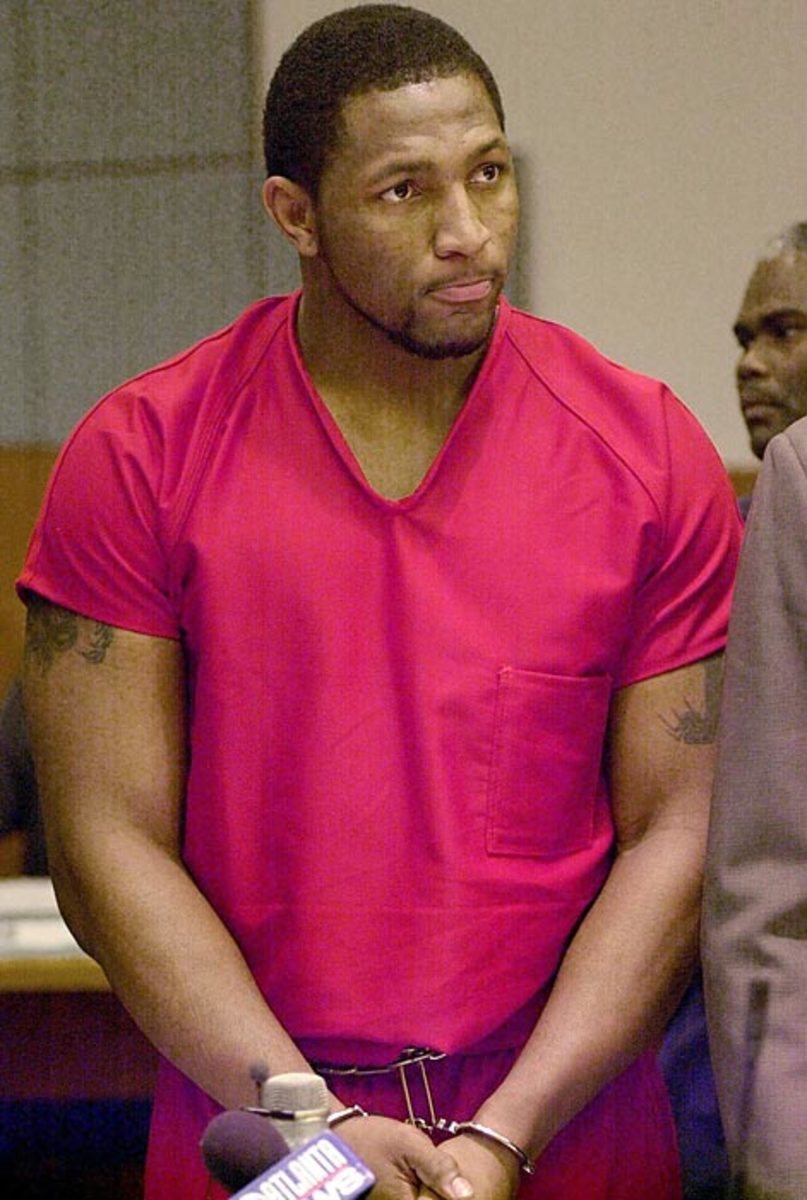
Super Bowl Sunday, 2000. While the St. Louis Rams celebrated inside the Georgia Dome, two men from Akron, Ohio were bleeding to death on a Buckhead street. At the center of it all was Ray Lewis, one of the NFL's most feared linebackers, wearing a cream-colored suit that would disappear by sunrise. This is the story of a champagne bottle, tactical knives bought at a sporting goods store, and how silence became the most powerful weapon of all.
Super Bowl XXXIV Night Turns Deadly in Atlanta
January 31st, 2000. The St. Louis Rams had won Super Bowl XXXIV in Atlanta hours earlier. Confetti fell inside the Georgia Dome, and if you were in Atlanta that weekend, you were at the center of the universe.
Ray Lewis was 24 years old, already a Pro Bowl linebacker for the Baltimore Ravens. On the field, he was ferocious. Off the field, he moved with an entourage like many athletes did in that era. Two guys in that circle were Joseph Sweeting and Reginald Oakley. Sweeting had known Lewis since Miami. Oakley was newer to the group, from Baltimore, and according to witnesses, he had a volatile streak.
The Victims: Jacinth Baker and Richard Lollar from Akron
Jacinth Baker was 21. Richard Lollar was 24. Both from Akron, Ohio. They'd moved to Atlanta during the late 90s economic boom, trying to build something.
Richard Lollar was a barber. Lollar was so skilled that clients would hand him $100 for a fade. He loved to draw and sing. His fiancée was pregnant with their daughter, India, who'd be born months after his death. Lollar was the oldest of nine kids.
Jacinth Baker went by "Shorty." He was an artist and a painter. Both parents died when he was young. Both men had minor legal issues. Lollar for marijuana possession, Baker for cocaine possession and an open container violation. Defense attorneys would later weaponize those records. But on that night, they were young men celebrating in a city that felt electric.
Tactical Knives Purchased Two Days Before the Murders
Two days before the murders, Ray Lewis was at a Sports Authority in Gwinnett Place Mall for an autograph signing. While Lewis worked the crowd, Sweeting and Oakley were shopping in the same store. They bought knives. Tactical folding knives, specifically Gerber Chameleon IIs. This model has a finger hole in the blade designed to give you a secure, tactical grip. You can thrust hard without your hand slipping. It's built for combat.
Why buy weapons like that in the middle of a promotional event for an NFL star? Maybe they felt they needed protection. Maybe they always carried. Whatever the reasoning, those blades would pierce human flesh within 48 hours.
A friend of Lewis witnessed the knife purchase. Later, when Atlanta Police Homicide Lieutenant Mike Smith tried to interview this friend, the witness stormed out, accusing Smith of making a racist comment. That moment poisoned the entire investigation, creating a wall of distrust between Lewis's camp and the Atlanta Police Department.
The Fight Outside Buckhead's Cobalt Lounge
Early morning, January 31st. The Cobalt Lounge in Buckhead was the place to be. The club closed around 4:00 AM. Hundreds of people flooded onto East Paces Ferry Road. Ray Lewis and his group, maybe ten people total, walked toward their rented Lincoln Navigator limo. They were a couple hundred yards from the club when paths crossed with the group containing Baker and Lollar.
Reginald Oakley and someone from the Akron crew started jawing at each other. Then someone from the Akron group cracked a Moet champagne bottle across the side of Oakley's head. In his self-published book years later, Oakley described everything exploding after that moment.
This is where the entire legal case pivots. The defense would build their strategy around that bottle. Getting hit in the skull with glass is deadly force. Everything that followed was a reaction to being attacked. The prosecution saw it differently. The verbal confrontation was mutual, and pulling knives turned a fistfight into a massacre.
Two Men Stabbed to Death on a Buckhead Street
The street erupted. The fight spilled from the sidewalk into traffic. It happened fast. Chester Anderson, testifying for the prosecution, initially said he saw Ray Lewis square up and throw a kick. Duane Fassett, the limo driver, first told police he saw Lewis throwing punches.
Jacinth Baker was pursued. Witnesses saw him lifted off the ground and slammed onto the asphalt. While he was down, being beaten, he was stabbed four times. The fatal wound went through his heart. He died within seconds.
Richard Lollar was cornered nearby. He took five stab wounds. Deep punctures. He bled to death on the street.
The medical examiner's testimony would later confirm the wounds matched a blade capable of serious penetration. Exactly like those Gerber knives. The wounds weren't slashes. They were thrusts. Targeted at vital organs.
Ray Lewis's Role: What Really Happened
So where was Ray Lewis while this was happening? Lewis has consistently maintained he was trying to pull Oakley and Sweeting away, trying to get everyone into the limo. He points out he was wearing a cream-colored suit, jewelry, and a mink coat worth a quarter million dollars. His logic goes: why would someone dressed like that dive into a street brawl?
The prosecution had a different theory. They found Jacinth Baker's blood inside the limo. If the killers had victim's blood on them, and Lewis was right there in close contact, he was involved. Even if he never held a knife, if he was punching someone while they were being stabbed, he was legally part of the murder under Georgia law.
The group scrambled into the Lincoln Navigator. As they pulled away, gunshots rang out. Bullets struck the limo. So the Akron group was armed with firearms too.
The Code of Silence and Missing Evidence
Inside that limo is where the cover-up began. According to driver Duane Fassett's statement, Ray Lewis took control. He told everyone, "Just keep your mouth shut and don't say nothing." He specifically instructed Fassett, "You don't know anything. Don't say who was in the limo." Those words became the obstruction of justice charge Lewis eventually pled guilty to.
During the ride back to their hotel, Lewis asked Sweeting what happened. Sweeting said, "Every time they hit me, I hit them." As he spoke, he made a punching motion with a closed fist. That's the motion someone makes when holding a tactical knife. It was essentially a confession, disguised as self-defense.
The Mystery of Ray Lewis's Blood-Soaked Suit
Ray Lewis wore that cream-colored suit that night. He also wore the mink coat. Police recovered the mink coat. The suit disappeared.
Evelyn Sparks, a passenger in the limo, testified that she witnessed someone from the entourage dump a white hotel laundry bag into a garbage dumpster outside a fast-food restaurant near their hotel. Prosecutors believed that suit was soaked in blood.
Lewis says he doesn't know what happened to it. But that missing piece of clothing haunts this case. It's the bloody glove that was never found.
The destruction went further. Jessica Robertson, Lewis's girlfriend at the time, received immunity and testified that she helped destroy photographs taken at the Cobalt Lounge earlier that night. Those photos would have documented exactly what everyone wore. She burned them in a hotel room sink.
Ray Lewis Arrested and Charged with Murder
Ray Lewis was arrested that afternoon. The image of the Pro Bowl linebacker in handcuffs broadcast worldwide. Atlanta Mayor Bill Campbell said Lewis had "blood dripping from his hands." District Attorney Paul Howard was facing re-election. He rushed the indictment. On February 11th, eleven days after the murders, a grand jury indicted Lewis, Oakley, and Sweeting on murder charges. The state wanted life in prison.
Lewis hired the best legal team money could buy. Ed Garland and Don Samuel were Georgia legends. Bruce Harvey represented Oakley. Steve Sadow represented Sweeting.
Star Witness Changes Story on the Stand
The prosecution's case collapsed during trial. Duane Fassett, their key witness, changed his story on the stand. He said police coerced him. He softened everything, saying he only saw Lewis raise his hand to break things up, never strike anyone. Without Fassett identifying Lewis as an attacker, the murder charge against Lewis crumbled.
Two weeks in, DA Paul Howard realized he was losing. He cut a deal. Lewis pled guilty to one misdemeanor count of obstruction of justice. He got 12 months probation. In return, he testified against Oakley and Sweeting.
When Lewis took the stand, he used a laser pointer to demonstrate Sweeting's stabbing motions. He confirmed the knife purchase. He confirmed the confession in the car. But he framed everything in a context of men under attack.
Self-Defense Verdict Shocks the Nation
The defense hammered self-defense. The Akron group initiated violence with the bottle. Under Georgia law, if you face death or great bodily harm, you don't have a duty to retreat. Knives against a mob with bottles and guns was proportional response.
June 12th, 2000. The jury deliberated less than five hours. Verdict: Not guilty on all counts for both Reginald Oakley and Joseph Sweeting.
For the families of Jacinth Baker and Richard Lollar, the verdict was crushing. Two men were dead on a street in Buckhead, and the legal system determined no crime occurred.
Ray Lewis's Super Bowl Redemption and Legacy
Ray Lewis settled civil lawsuits with both families. India Lollar, Richard's daughter, received around $1 million. The Baker family got an undisclosed sum.
The 2000 season became Lewis's resurrection. He played with supernatural intensity. The Ravens defense that year is still considered one of the greatest in NFL history. Super Bowl XXXV, exactly one year after the murders, Lewis was named MVP.
He reinvented himself as a spiritual leader. Quoting scripture. Preaching redemption. Some people saw genuine transformation. Others saw calculated image repair.
That cream-colored suit has never been found. It's probably in a Georgia landfill, holding whatever truth exists about Ray Lewis's involvement that night. Jacinth Baker's family and Richard Lollar's family watched Lewis become a Hall of Famer, a media personality, a legend. For them, justice was something you could buy with an NFL contract. Two young men died over nothing. Over words and ego and champagne. The man at the center walked away to glory. But those shadows follow him. They always will.

Host | Creator
Joe runs 10 Minute Murder because he's been trying to figure out since the '90s why humans are such spectacular disasters, when the Menendez Brothers and O.J. Simpson turned murder trials into must-see TV. While his classmates were watching Saturday morning cartoons, little Joe was watching Court TV and thinking, "What is wrong with people?" Thirty years later, he still doesn't have a good answer, but he's got a podcast about it.
When he's not studying the worst decisions ever made by our species, Joe screams supportive threats at the Buffalo Bills, reads everything he can get his hands on, and goes to stand-up comedy shows to remember that humans can be funny on purpose instead of by accident. Most nights you'll find him on his couch, yelling "You IDIOT" at a murder documentary like the killer can hear him through the screen. He calls it research. His therapist calls it "an interesting coping mechanism."
The Zombie Hunter Murders: Phoenix's Most Haunting Cold Case Finally Solved

 Spotify
 Apple Podcasts
 Pandora
 Amazon Music
 Podchaser
 Spreaker
 RSS Feed
 Audible
 Castbox
 iHeartRadio
 Castro
 Deezer
 YouTube