Bloody Bill Anderson: The Civil War Guerrilla Who Created Jesse James
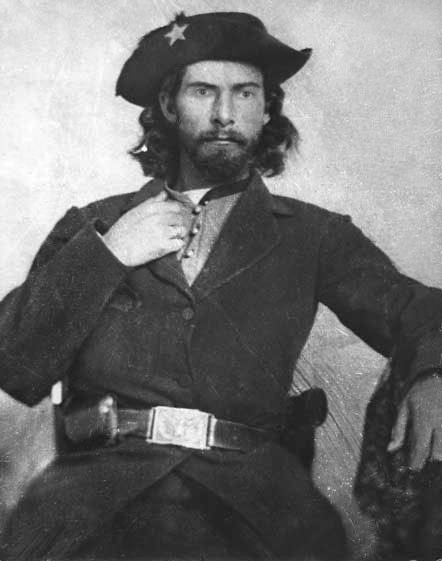
In September 1864, a Confederate guerrilla named Bloody Bill Anderson stopped a train in Centralia, Missouri, lined up 22 unarmed Union soldiers, and had them executed one by one. Then he scalped them. An hour later, he ambushed a Union company and killed 123 more men in less than twenty minutes. Standing next to him through all of it was a 16-year-old kid named Jesse James, learning every lesson. This is the story of the man who created the American outlaw.
The Man Who Taught Jesse James How to Kill: Bloody Bill Anderson's Reign of Terror
When Grief Becomes a Weapon
So here's what you need to understand about William T. Anderson. He didn't start out as a monster. He started out as a horse thief, which honestly feels almost quaint compared to what he became. Born around 1840 in Kentucky, his family moved to Kansas in 1857, right into the middle of what people were already calling Bleeding Kansas. Pro-slavery and anti-slavery settlers were literally murdering each other over whether Kansas would be a free state.
The Anderson family was pro-Southern in a Free-State territory, which immediately made them targets. William and his brother Jim started stealing horses, running them across state lines, making decent money at it. They were small-time frontier criminals.
Everything changed on May 12, 1862. A former judge named A.I. Baker shot and killed Anderson's father over political disputes. William and Jim had to run to Missouri because they were already wanted for horse theft. Their sisters followed.
Once in Missouri, the brothers joined Confederate bushwhackers. These weren't regular soldiers. They were guerrillas who raided anti-slavery settlements, killed civilians, and disappeared before anyone could catch them. But Anderson had unfinished business with Judge Baker.
On July 3, 1862, Anderson came back to Kansas with his gang. They lured Baker out of his house, shot him, kicked him down into his cellar, and then they did something that tells you everything about what Anderson was becoming. They rolled a heavy barrel over the cellar door to trap him inside, set the house on fire, and made sure Baker burned alive. They stole his horses and rode off bragging about it.
That's when William Anderson stopped being a thief and became something else entirely.
The Building Collapse That Created Bloody Bill
By 1863, the Union was trying to stop the bushwhackers. These guerrillas were using their families for intelligence and supplies. So Union officers started rounding up female relatives of suspected Confederate guerrillas and throwing them in makeshift prisons in Kansas City.
On August 14, 1863, a three-story brick building being used as a prison collapsed. Several women died. Several more were badly injured. Among them were William Anderson's sisters. Josephine Anderson was killed. Mary Anderson was seriously injured.
The official cause has never been definitively established. But there were immediate rumors that drunken Union guards had been bragging in a tavern that they'd deliberately removed support columns in the cellar. Whether that's true or not, Anderson believed it. And that belief transformed him completely.
People who knew him said he became unhinged. Whatever restraint he'd been operating under disappeared. His grief and rage fused into a single purpose. The Union had killed his sister. The Union would pay in blood.
Eight days after the building collapsed, William Quantrill led about 400 Confederate raiders into Lawrence, Kansas, and killed between 160 and 190 men and boys. They burned 185 buildings. Anderson was right there in the middle of it. The Lawrence Massacre was retaliation for the prison collapse. The raiders spared the women and children, which tells you this was a calculated, gendered act of revenge.
The Union response was General Order No. 11, which forced thousands of civilians to evacuate four Missouri counties. The idea was to deprive the guerrillas of their support base. Instead, it created a logistical paradise. All those abandoned farms meant unlimited access to livestock, feed, and food. The Union accidentally made it easier for Anderson to survive and grow stronger.
The Making of America's Deadliest Guerrilla Band
By spring 1864, Anderson had split from Quantrill and formed his own guerrilla company. About 80 men who operated like a death squad. They wore Union uniforms to get close to their targets. They showed no mercy. Anderson personally adopted a policy of giving no quarter, torturing prisoners, cutting off ears.
His violence wasn't random. In one raid, he targeted a wealthy Union sympathizer who had freed his slaves. Anderson beat the man, raped his 12- or 13-year-old Black servant, and then trampled the man with a specially trained horse. The victim died from his injuries two years later. This was terrorism, racial hatred, and personal cruelty all wrapped into one package.
Anderson was tall, bearded, dressed with style, but people who met him talked about his eyes. They said they looked like burning coals. He earned the nickname Bloody Bill through sheer, relentless savagery. His men decorated their saddles with scalps taken from dead Union soldiers.
Jesse James at about 16 years old
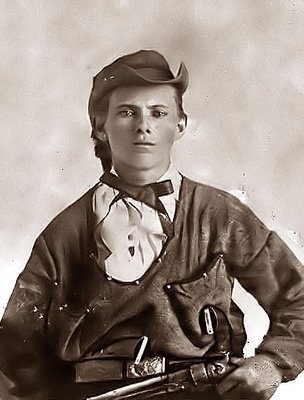
And right there in the middle of this was 16-year-old Jesse James, who joined Anderson's band in 1864 along with his older brother Frank. Jesse's immediate mentor was Anderson's chief lieutenant, a small, ruthless killer named Archie Clement. People called Clement "Bill Anderson's scalper and head devil." He taught young Jesse James that murdering unarmed men was not only acceptable, it was expected.
Jesse James didn't become an outlaw despite his Civil War experience. He became an outlaw because of it. He learned from the best, and Bloody Bill Anderson was the best at what he did.
Centralia: The Day Everything Went Wrong for the Union
Throughout the summer of 1864, Anderson's force rampaged across central Missouri. They ambushed Union patrols. They burned railway property. All of it was building toward September 27, 1864, in a small town called Centralia.
Anderson and 60 to 80 of his bushwhackers rode into town, looted it, robbed a stagecoach, and drank all the liquor they could find. Then they did something that had never been done before in the Civil War. They captured a passenger train belonging to the North Missouri Railroad. First train capture by Confederate guerrillas in the entire war.
On that train were 22 to 24 unarmed Union soldiers, probably recruits or men heading home. Anderson berated them, selected one sergeant named Thomas Goodman for a potential prisoner exchange, and then had his men execute the rest in a line. One by one. Then they mutilated and scalped the bodies. Goodman, the only survivor, later called it the most monstrous and inhuman atrocity he'd ever witnessed. Anderson's men set the train on fire and sent the burning engine down the tracks toward the next town.
But the real disaster was still coming.
The smoke from the burning train drew a Union major named Andrew Johnston and 147 men from the 39th Missouri Volunteer Infantry. These were raw recruits, inexperienced, riding on farming horses and mules. They were armed with slow, muzzle-loading Enfield rifles. When Johnston challenged Anderson outside Centralia, Anderson's guerrillas responded with a mounted charge.
It was a slaughter. The Union line collapsed immediately. Anderson's men had rapid-fire revolvers. They knew how to fight on horseback. They were experienced killers facing green troops. Out of 147 Union soldiers, 123 were killed. Only one was wounded. Anderson's force lost three men.
Frank James later claimed his younger brother Jesse fired the shot that killed Major Johnston. The Centralia Massacre demonstrated that Anderson was more than a sadistic killer. He was a cunning, lethal commander who knew exactly how to exploit his enemy's weaknesses.
The Death and Mutilation of Bloody Bill
The Centralia Massacre made Anderson the most hunted man on the border. One month later, on October 26, 1864, Union forces lured Anderson's band into an ambush near Albany in Ray County, Missouri. Anderson was killed in the fight. His men tried desperately to recover his body, losing up to ten more men in the attempt, but the Union held the corpse.
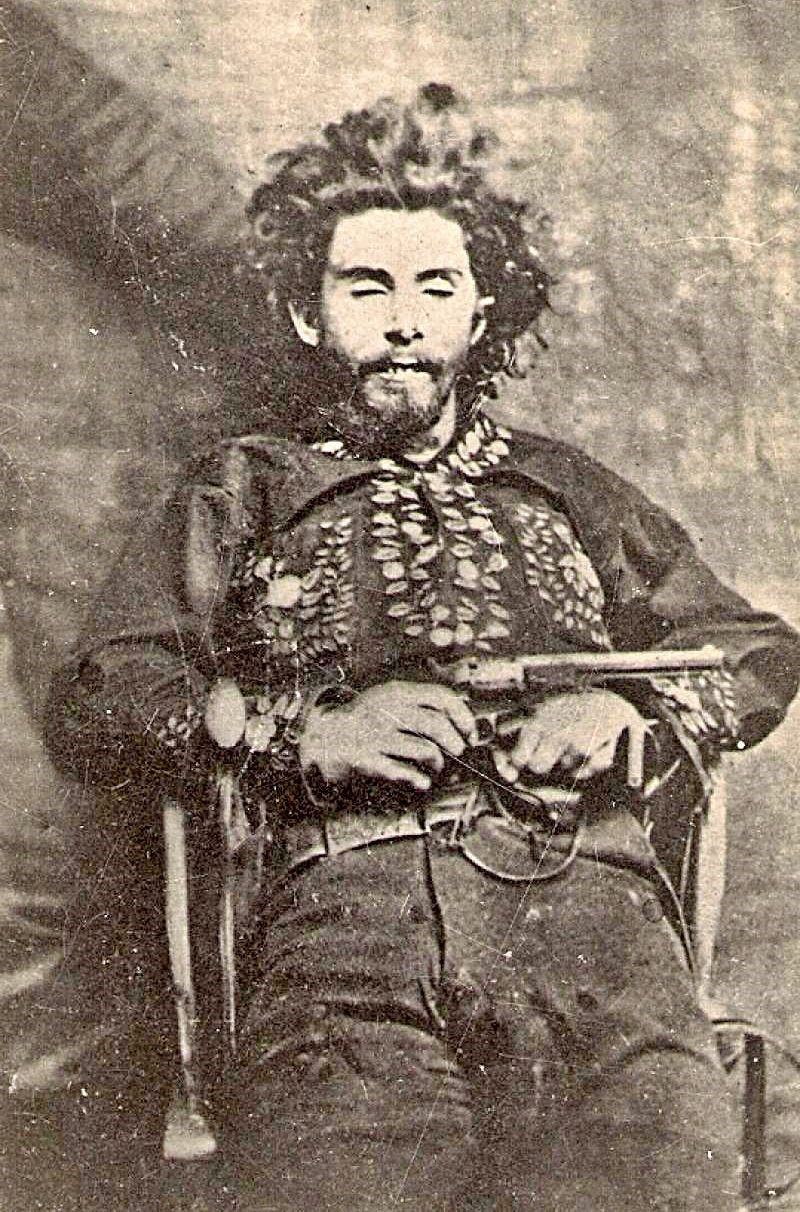
What happened next tells you everything about how brutal the border war had become. Union militia took Anderson's body to Richmond, Missouri. A doctor named Richard B. Kice photographed him. In the tintype, Anderson is propped up, wearing his guerrilla shirt, with a pistol in his hand and a Union soldier holding his head upright for clear identification.
Then they decapitated him. Officially. They put his head on a spiked telegraph pole and dragged his body through the streets before burying it in an unmarked grave.
The Union wanted to prove Bloody Bill was dead. They wanted to terrorize his followers. Instead, they created a martyr. That public mutilation gave Anderson's surviving men a visceral reason to keep fighting.
The Legacy: From Bushwhacker to Bank Robber
After Anderson died, Archie Clement took command of the guerrilla band. Jesse and Frank James stayed with him. They refused to recognize the end of the Civil War. They kept fighting even after the Confederate surrender in 1865.
In 1869, the James-Younger gang robbed a bank in Gallatin, Missouri. During the robbery, Jesse James shot and killed the cashier, John Sheets. This wasn't about money. Jesse believed Sheets was Samuel P. Cox, the man he thought had killed Bloody Bill Anderson. He was wrong about the identity, but the motive was clear. The first major crime of the James-Younger gang was revenge for Anderson's death. The violence of the Civil War didn't end in 1865. It moved from the battlefield to the bank.
William T. Anderson was killed at 24 years old after a two-year reign of terror. Union forces tried to erase him by mutilating his corpse and burying him without a marker. But in 1967, over a century later, a sympathizer convinced the United States government to officially mark Anderson's grave with a headstone that highlighted his service to the Confederacy.
Anderson's real legacy is Jesse James. The systematic murder of unarmed men, the refusal to show mercy, the belief that violence is the only legitimate response to grievance. That was Bloody Bill's lesson. Jesse James learned it at 16 years old, and he carried it for the rest of his life. The American outlaw tradition didn't start with bank robberies and train heists. It started with a guerrilla commander who decorated his saddle with scalps and taught a teenager that murder was business.
That's the story of Bloody Bill Anderson. The butcher of Centralia. The man who created Jesse James. The ghost that haunted the American frontier long after his head came off that telegraph pole.

Host | Creator
Joe runs 10 Minute Murder because he's been trying to figure out since the '90s why humans are such spectacular disasters, when the Menendez Brothers and O.J. Simpson turned murder trials into must-see TV. While his classmates were watching Saturday morning cartoons, little Joe was watching Court TV and thinking, "What is wrong with people?" Thirty years later, he still doesn't have a good answer, but he's got a podcast about it.
When he's not studying the worst decisions ever made by our species, Joe screams supportive threats at the Buffalo Bills, reads everything he can get his hands on, and goes to stand-up comedy shows to remember that humans can be funny on purpose instead of by accident. Most nights you'll find him on his couch, yelling "You IDIOT" at a murder documentary like the killer can hear him through the screen. He calls it research. His therapist calls it "an interesting coping mechanism."
Sheila and Clay Fletcher: The Parents Who Let Their Daughter Die

 Spotify
 Apple Podcasts
 Pandora
 Amazon Music
 Podchaser
 Spreaker
 RSS Feed
 Audible
 Castbox
 iHeartRadio
 Castro
 Deezer
 YouTube