Spotify

 Apple Podcasts

 Pandora

 Amazon Music

 Podchaser

 Spreaker

 RSS Feed

 Audible

 Castbox

 iHeartRadio

 Castro

 Deezer

 YouTube
The Golden State Killer: When Evil Wore a Badge

The Golden State Killer: When Evil Wore a Badge We all have that one neighbor who seems a little off, right? Maybe they're too quiet, maybe they mow their lawn at weird hours, maybe they wave just a little too enthusiastically. Well, Joseph James...
The Golden State Killer: When Evil Wore a Badge
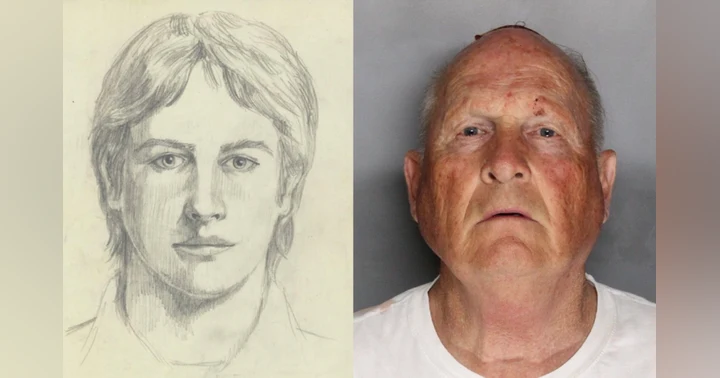
We all have that one neighbor who seems a little off, right? Maybe they're too quiet, maybe they mow their lawn at weird hours, maybe they wave just a little too enthusiastically. Well, Joseph James DeAngelo was that neighbor for decades, except his secret wasn't hoarding cats or playing music too loud. For forty years, this guy managed to hide the fact that he was one of California's most prolific serial killers while living completely under the radar as a grandfather in suburban Sacramento.
Here's what gets me about this case: DeAngelo wasn't some drifter operating in the shadows. He was a police officer. He worked in the burglary unit while actively committing burglaries. He investigated the exact crimes he was committing on his days off. The man was literally getting paid to learn how to be a better criminal, and nobody noticed.
We're talking about someone who terrorized California for over a decade, committing more than 50 sexual assaults and 13 murders across 11 counties. He had a system, a method, and the professional knowledge to stay ahead of every investigation. Until DNA technology caught up with him in 2018 and his whole carefully constructed life fell apart.
This story goes way beyond the typical "bad guy gets caught" narrative. It's about how childhood trauma can spiral into unimaginable violence, how institutions can fail us, and how survivors can find the strength to seek justice even decades later. It's also about the absolutely wild way genealogy websites helped solve one of America's most notorious cold cases.
So grab your coffee, settle in, and let's talk about Joseph James DeAngelo, the Golden State Killer, and how evil can hide behind a badge for forty years.
#GoldenStateKiller #JosephJamesDeAngelo #TrueCrimePodcast #SerialKiller #TrueCrimeCommunity #ColdCase #DNAEvidence
💡 Haven’t subscribed yet? Now’s your chance! Hit that subscribe button, and you’ll never miss your favorite bite-sized dose of true crime.
📢 Love true crime? Share the love! Got a friend who’s as obsessed with true crime as you are? Share the podcast with them and let the bingeing marathon begin.
📱 Get Social With Me: Follow along on social media for behind-the-scenes goodies, sneak peeks of upcoming episodes, and the occasional “should I really post this?” moment.
📬 Your Turn! Have a case you’d love for me to cover? Or just want to say hi? Drop me an email—I love hearing from you and might just feature your suggestion in an upcoming episode!
Thanks for being here, and let’s make 2025 the year of binge-worthy true crime. 🖤
(BTDubs- If you're into the brief and bingeable vibe, search for and subscribe to my other podcast: 10 Minute Mystery)
10minutemurder.com
email: joe@10minutemurder.com
Become a supporter of this podcast: https://www.spreaker.com/podcast/10-minute-murder-bingeable-true-crime-stories--4603604/support.
0:00 What if I told you that for decades, one of California's most wanted serial killers was hiding in plain sight as a suburban grandfather. Joseph James DiAngelo spent his career as a cop investigating burglaries while committing them himself. He fooled his family, his colleagues, and entire communities for 40 years. Then in 2018, a genealogy website changed everything. This is the story of how evil wore a badge and how DNA finally brought it all crashing down. I'm going to tell you all about Joseph James DiAngelo and this story is going to feel like watching someone fall down a very long, very dark staircase.
1:03 Born in 1945 in Bath, New York, right as World War II was ending, DiAngelo came into this world during a time when the country was trying to figure out what normal looked like again. His dad was a career military man, a sergeant in the US Army, and he ran their household like a boot camp. Now, military families move around a lot. I can tell you that from personal experience and the DiAngelo's were no exception. They bounced around from base to base, never really settling anywhere long enough for Joseph to put down any roots. Here's where things get complicated. DiAngelo's older sisters would later say that their father's idea of discipline crossed some pretty serious lines.
1:45 When Joseph broke the rules and apparently he did that often, the punishments weren't your typical "go to your room" situation. We're talking about abuse that left lasting marks, both physical and psychological. Like there's another piece to this puzzle that's absolutely crucial to understand. When the family was stationed in Germany, Joseph's older sister Constance was assaulted by two airmen. This wasn't some minor incident. This was a violent attack that fundamentally changed how this family functioned. And for Joseph, watching his sister go through that trauma appears to have planted something dark in his developing mind. By the time Joseph hit his teenage years, he was already showing some seriously troubling behavior.
2:29 While the other kids were figuring out dating and driving, Joseph was breaking into neighbor's houses. Not for money or valuables, he was taking weird personal stuff, a single earring from a set. Random coins from a kid's piggy bank. Women's underwear. And then there were the animals. Joseph started hunting animals, which any psychologist will tell you is a massive red flag. When someone can't fight back against a larger, stronger person, sometimes they turn around and hurt something smaller and weaker. It's a pattern that would define Joseph's entire life. After high school, Joseph joined the Navy and served during the Vietnam War.
3:10 He was stationed on two different ships and saw active duty. When he came back to the States, he did what a lot of veterans did. He went to school and then looked for steady work. Joseph DiAngelo worked for the Auburn Police Department from 1976 to 1979. A time span when he was allegedly committing dozens of rapes. The irony here is staggering. He was working in the burglary unit, investigating the exact crimes he'd been committing since he was a teenager. Think about that for a second. The man spent his days learning exactly how police investigated break ins, what evidence they looked for, and how to avoid getting caught. He was literally getting paid to become a better criminal.
3:52 He served in Auburn from August 1976 to July 1979 when he was arrested for shoplifting a hammer and dog repellent. He was sentenced to six months of probation and fired that October. Now you might be thinking why would someone risk their entire career over a hammer and some dog repellent? Well, hold that thought, because it's about to make perfect sense. From Joseph got fired, he didn't go quietly. During the process of being fired, DiAngelo threatened to kill the chief of police and allegedly stalk the chief's house. His former colleagues got a glimpse of who he really was beneath that badge, but they had no idea how deep this rabbit hole actually went.
4:36 Here's what we need to talk about. What Joseph was really doing during those years as a police officer. The first crime thought to be connected to what they were calling the East Area Rapist took place on June 18, 1976, when a man broke into a home in Rancho Cordova, a Sacramento suburb, and assaulted a woman in her home. But he'd been escalating for a while. In 1975, he'd been stalking the Snelling family, particularly their 16-year-old daughter. Her father, Claude Snelling, had already chased off a masked prowler from under her bedroom window once, but Joseph came back and this time he made it inside their house. In the early morning hours, Claude heard strange noises and went to investigate.
5:19 He found a masked man attempting to kidnap his daughter. Claude fought back and saved his child, but Joseph was prepared for resistance. He shot Claude, who died from his injuries. Joseph had crossed another line, from Berglor and Stonker to killer. When Joseph made so terrifying, it wasn't the random violence. It was the methodical way he operated. He would stalk potential victims for weeks, sometimes months, learning their routines, their vulnerabilities, their schedules. He'd break into homes multiple times before the final attack, leaving behind tools he'd need later. Shulases for binding, weapons for threatening. During his attacks, Joseph would spend hours in his victim's homes.
6:02 He'd eat their food, drink their beer, rummage through their personal belongings. One survivor described thinking he'd left, only to have him reappear and continue the assault. It was psychological torture on top of the violence. And there was something else. He'd often mumble about someone named Bonnie during these attacks. Bonnie was a woman he'd been engaged to years earlier who had left him. He was literally taking out his romantic failures on innocent women. In 1978, Joseph's violence escalated again. He encountered Brian and Katie Majuri, a young military couple out walking their dog. Brian was 21, Katie was 20.
6:45 They were killed for the simple crime of being in the wrong place at the wrong time. Joseph had officially become a serial killer. Police believed that the Golden State Killer, Joseph James DeAngelo, is the man behind a dozen or more heinous murders and dozens of rapes across California, spanning from the Sacramento area all the way to Orange County in Southern California between 1976 and 1986. On June 29, 2020, hearing the 74-year-old former police officer admitted to a total of 161 crimes, involving 48 victims, including dozens of rapes that could not be charged because of the statute of limitations on prosecuting them had long ago expired.
7:29 Let me put that into perspective. He committed 13 known murders, over 50 rapes and 120 burglaries up and down the state of California in 11 different counties. This was a decades-long reign of terror. For 40 years, Joseph James DeAngelo thought he'd gotten away with it. He used his police training to stay ahead of investigators, always wearing gloves, always planning his escape routes, always knowing exactly what evidence to avoid leaving behind. But he never counted on science catching up with him. In 2018, investigators used DNA evidence collected from crime scenes in the 1970s and uploaded it to GED match, a genealogical database.
8:14 The DNA didn't match anyone in the system directly, but it showed family connections. Investigators built a family tree and narrowed it down to Joseph James DeAngelo. After 40 years of hiding in plain sight, living as a grandfather in a quiet neighborhood, his past finally caught up with him. When Joseph was arrested, something fascinating happened during his interrogation. He started talking about an alter ego named Jerry. He claimed that Jerry was the one who made him commit these crimes. That Jerry was a part of him that he couldn't control. "I didn't have the strength to push him out. He made me. He went with me. It was like in my head. I mean, he's a part of me.
8:55 I didn't want to do those things. I pushed Jerry out and had a happy life. I did all those things. I destroyed their lives. So now I've got to pay the price." Now I'm obviously not a psychologist, but this sounds to me like someone who spent decades perfecting the art of not taking responsibility for his actions. The killer was at large for decades until DNA evidence led to the arrest of Joseph DeAngelo in 2018, who pleaded guilty in June 2020. By the time he was sentenced, Joseph was 74 years old, an elderly man who had fooled his own family for decades. The statute of limitations had run out on most of his sexual assault charges, but he could still be held accountable for murder.
9:38 In August 2020, James Joseph DeAngelo was sentenced to multiple consecutive life sentences without the possibility of parole. The Golden State Killer, Joseph James DeAngelo's story, is a reminder that monsters don't always look like monsters. They can be your neighbor, your coworker, even the police officer who's supposed to protect you. For 40 years, he lived a seemingly normal life while carrying the weight of unimaginable violence. The survivors of his crimes showed incredible courage in coming forward and testifying. Their strength helped ensure that even decades later, justice could still be served. And thanks to advances in DNA technology, cases that once seemed impossible to solve are finding resolution.
10:23 Joseph James DeAngelo thought he was smarter than everyone else. In the end, he was wrong. Thanks for listening to 10 Minute Murder, binge-abull true crime stories. My name is Joe, I'm the host, it's a pleasure to meet you. That is, if you're a new listener to the podcast, welcome. Make sure you hit subscribe wherever you're listening to this right now, and also go to 10minute murder.com, and there you'll find all kinds of information about the podcast. You can also, if you go to the website, send me a message, send me an email, and this is one of those. Subject for the Q&A segment.
11:03 Hi Joe, totally random, but I've always wondered, what is your process for picking which cases to cover? Like are there cases you won't do because they're too recent, too dark, or just too weird? Thanks for being my favorite voice in the crime podcast pile. Jess from Oakland. Jess thank you for the email, and the answer is, I don't pick the cases anymore. I used to, at the very beginning of this podcast, in its first initial weeks, I would pick all the stories that I covered. The ones that were most interesting to me, and the podcast did okay. It was fine. But then when I started doing the cases that you listening suggest to me, that's when it really started popping off, started doing numbers at that point, and I realized, oh, I suck at picking cases.
11:48 So that's basically what I exclusively do now. Every now and then I'll add one that I just want to do because I think it's interesting, but for the most part, 90% of the time, it's something that one of you listening has submitted to me and asked me to cover it. In the process of that is, you tell me about the case you want me to talk about, and then I'll go and see what information is out there and what I can find. And if it's, I think it's interesting and will add to the podcast and will be something that I think is interesting to cover on the podcast. Or more importantly, is there enough information about that story to cover on the podcast? So that's the normal process of that. And if you want to suggest a story, you can go to 10minuteMurder.com and do it that way. Alright, that's going to do it.
12:28 Thank you so much for listening to the podcast. I'll see you next time.