
Blood in the Rocket City: The 1998 Franklin Family Massacre
In 1998, in a subdivision called Camelot in the safest part of Huntsville, Alabama, a seventeen-year-old boy from an aerospace family came home from school and quietly gathered a sledgehammer, a hatchet, a butcher knife, and a tool nobody could explain. By the time the streetlights came on, two of his family members were dead, three more were fighting for their lives, and a neighborhood that thought it had escaped the rest of America was about to learn it had not.
The Jeffrey Franklin Case: Inside the 1998 Camelot Drive Family Murders in Huntsville, Alabama
Camelot in Crisis: The South Huntsville Subdivision in 1998
If you’ve never been to Huntsville, Alabama, here’s the deal. They call it the Rocket City and the nickname is earned. NASA set up shop in north Alabama after World War Two, and the whole region rearranged itself around aerospace and defense. By the late nineties, Huntsville was full of engineers and scientists raising kids in clean little subdivisions with hopeful names. The one at the center of this story was called Camelot. That was the actual name on the street sign, which in retrospect feels like a novelist trying too hard, except it was just the real neighborhood. South Huntsville in 1998 was a place where lawns stayed well-manicured and people left bicycles on front yards without worrying about them being stolen. The local industry was space and defense and cotton, in roughly that order.
Who Was Jeffrey Brendan Franklin Before March 10?
The Franklins lived at 1305 Camelot Drive. Dad was Gerald, an engineer at a tech firm called VMIC. Mom was Cynthia. They had five kids together. Jeffrey was the oldest at seventeen, then fourteen-year-old Sara, then Stacey, then eight-year-old Timothy, and the baby was Christopher, who was six. To the neighbors, the Franklins looked exactly like the family the whole subdivision had been built for. Inside the house, things were a lot more complicated, and most of the complication had to do with Jeffrey.
ADHD, Prozac, and Ritalin: Pediatric Psychiatry in the Late 1990s
Jeffrey had been diagnosed with ADHD and major depressive disorder, and his doctors had him on a daily combination of Prozac and Ritalin. Before anybody comes after me, I’m not anti-medication. I’m telling you what was happening in 1998. Pediatric psychiatry in the late nineties was its own little wild west. Long-term safety data on SSRIs in a developing teenage brain was thin, and data on stacking SSRIs with stimulants in teenagers was thinner. The Franklins trusted their doctors, and most parents in 1998 did the same.
Three Days Without Sleep: The Buildup to March 10
By early March of 1998, Jeffrey was coming apart. According to later interviews and his own writings, he had gone roughly three days without sleeping, and he was hearing voices telling him to kill his family. He had been writing about it for weeks. Investigators would later recover journals that detailed what he planned to do, along with pornographic and violent drawings and explicit Satanic invocations. One entry read, in part, “Hail Satan, shall offer up my mother and sister to thee Lord Satan.” That is the seventeen-year-old who came home from school on March 10, 1998.
March 10, 1998: The Attack on 1305 Camelot Drive
That afternoon, Jeffrey walked through his own house gathering an arsenal. He grabbed a two-pound sledgehammer from the garage, a hatchet, a butcher knife from the kitchen, and a rat-tail file, which is a long tapered metal tool mechanics use for shaping holes in metal. That last item is the one that haunts forensic psychologists. It is not a tool you grab to do anything rational with.
According to retired Huntsville Police investigator Mac McCutcheon, who handled the case at the time and later became an Alabama state representative, Cynthia Franklin was killed first. Jeffrey stabbed his mother with the rat-tail file. He then attacked fourteen-year-old Sara, slashing her neck. After his father Gerald arrived home, Jeffrey bludgeoned him to death with the sledgehammer. He then went after his two youngest brothers, eight-year-old Timothy and six-year-old Christopher, with the hatchet. By every medical expectation, Sara, Timothy, and Christopher should not have survived. By something close to a miracle, all three did. Their sister Stacey was not physically harmed. By the end of the afternoon, the Franklin family had gone from seven people to four traumatized children, no parents, and a teenager fleeing the scene in his parents’ car.
The Chase from Ditto Landing
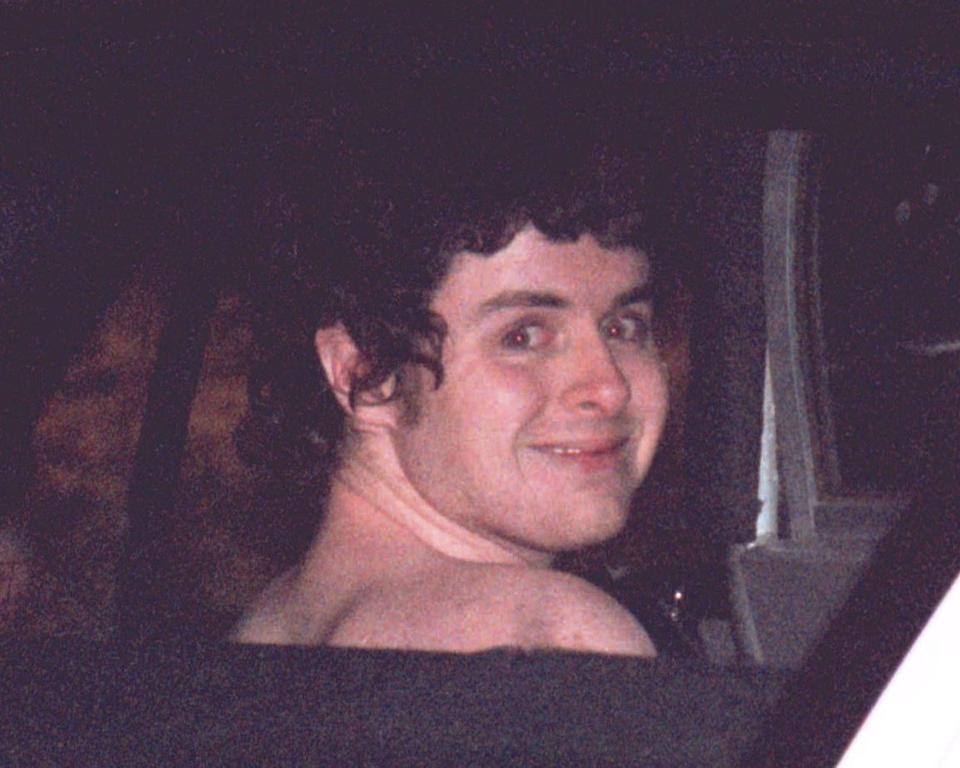
A neighbor saw Jeffrey leave the house covered in blood and called police. Another neighbor spotted one of the children outside in a puddle of blood and dialed 911 too, thinking they were calling about one injured child. The first responders had no idea what they were walking into. By the time officers got there, Jeffrey was already gone. The chase started down at Ditto Landing on the Tennessee River and ended in a yard not far from the Franklin home. Once officers finally got him into handcuffs, he was shirtless and spitting and cursing and making obscene gestures at officers and news crews. Carved into his chest was the outline of an upside-down cross. He had done that to himself.
The Survivors: Sara, Timothy, Christopher, and Stacey Franklin
Quick second on the survivors, because in most tellings of this case the focus rockets straight to Jeffrey and the legal circus and the kids almost vanish. Sara, Timothy, and Christopher are alive today because of an extraordinary medical response that afternoon. They spent years afterward in surgeries and therapy and rehabilitation. Stacey grew up in the aftermath. Whatever those four did with their lives later, they did it without the spotlight, because the spotlight stayed on their brother.
Detective Jeff Bennett and the Occult Investigation
After the arrest, investigators went through Jeffrey’s bedroom and found the journals, the drawings, and the Satanic writings. They brought in a now-retired Huntsville detective named Jeff Bennett, who was the department’s longtime expert on cults and occultism and who was also an active Baptist pastor at a church in Tennessee. Bennett interpreted Jeffrey’s writings as evidence of real occult involvement, and he told a local news investigation years later that Jeffrey had intended to ritually sacrifice members of his own family. To a religious Southern community in 1998, this was the cleanest possible story. The Satanic Panic of the eighties was still alive and well in middle America, and people wanted to believe that violence like this came from outside the family.
Most modern forensic psychologists read the case differently. They see a very sick seventeen-year-old who had not slept in days and who was already in a deep psychotic spiral. The Satanic content was the language his disintegrating brain reached for when nothing else made sense. The breakdown came first, and the imagery came after.
Treatment-Activation Syndrome and 1990s Juvenile Violence
Then there’s the medication question, which has never gone away. Treatment-activation syndrome is a condition where certain medications, especially SSRIs paired with stimulants, can push some patients into manic agitation and a break from reality. The late nineties produced a string of devastating juvenile crimes that all had one strange thing in common. Kip Kinkel in Oregon, on Prozac and Ritalin, killed his parents and opened fire at his school. Luke Woodham in Mississippi, on Prozac, killed his mother and opened fire at his school. Whether medication played a role on March 10 for Jeffrey Franklin has never been fully resolved.
The Mistrial and the Plea Deal in Madison County
By 1999, Alabama had ruled Jeffrey mentally incompetent to stand trial. He was sent to a secure psychiatric hospital, where clinicians spent over a year stabilizing him until he could understand the charges. The case went back to court in Madison County in late 2000. Prosecutors announced they were going after the death penalty. Jeffrey had been seventeen at the time of the murders, and Alabama law in 1998 allowed execution for crimes committed as a minor. That decision turned the case into an international story, and Amnesty International launched a global campaign focused specifically on it.
Jury selection started October 2, 2000. Three days in, the judge declared a mistrial because several prospective jurors had been openly talking about the case during selection. Faced with a change of venue, both sides settled. In 2001, Jeffrey Franklin pled guilty to two counts of murder and three counts of attempted murder. The state dropped the death penalty, and he was sentenced to five consecutive life prison terms.
How the Franklin Case Helped Shape Roper v. Simmons
Four years later, in 2005, the United States Supreme Court ruled in Roper v. Simmons that executing people for crimes they committed under the age of eighteen violated the Eighth Amendment. The court cited international human rights pressure as evidence of evolving standards of decency, and the Amnesty campaign around Jeffrey Franklin was part of that pressure.
Where Is Jeffrey Franklin Now? Bullock Correctional Facility and the 2027 Parole Hearing
Jeffrey Franklin is being held today at Bullock Correctional Facility near Union Springs, Alabama. He came up for parole in 2016 and the board denied him. He came up again in August 2022, and Madison County DA Robert Broussard drove down to Montgomery personally to argue against his release. Victim advocates filled the room. The board voted unanimously to deny parole and gave him the maximum five-year reset. His next hearing is August of 2027.
The Lasting Legacy of the Camelot Drive Murders
The Camelot subdivision is still there, and the house at 1305 Camelot Drive is still standing. The four kids who lived through that afternoon grew up and built private lives they have every right to keep private. Their parents are still gone, and their brother is still in prison. People want stories like this to have a clean explanation, and the Satanic theory of 1998 was certainly clean. The medication theory and the mental illness theory are far messier, and the honest answer is probably that all three were tangled together inside the head of a sick seventeen-year-old on a quiet street in Alabama.

Host | Creator
Joe runs 10 Minute Murder because he's been trying to figure out since the '90s why humans are such spectacular disasters, when the Menendez Brothers and O.J. Simpson turned murder trials into must-see TV. While his classmates were watching Saturday morning cartoons, little Joe was watching Court TV and thinking, "What is wrong with people?" Thirty years later, he still doesn't have a good answer, but he's got a podcast about it.
When he's not studying the worst decisions ever made by our species, Joe screams supportive threats at the Buffalo Bills, reads everything he can get his hands on, and goes to stand-up comedy shows to remember that humans can be funny on purpose instead of by accident. Most nights you'll find him on his couch, yelling "You IDIOT" at a murder documentary like the killer can hear him through the screen. He calls it research. His therapist calls it "an interesting coping mechanism."
The Monster of Atwater Village: The Timothy McGhee Case

 Spotify
  Apple Podcasts
  Pandora
  Amazon Music
  Podchaser
  Spreaker
  RSS Feed
  Audible
  Castbox
  iHeartRadio
  Castro
  Deezer
  YouTube