
Fifty Dollars and a Bus Ticket: The Robert Alton Harris Story
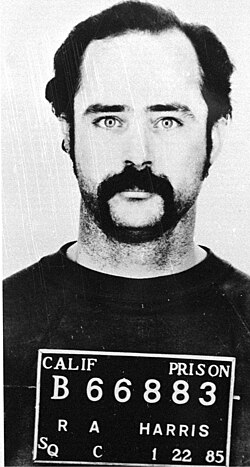
Two sixteen-year-old best friends sat in a parking lot eating cheeseburgers and planning a fishing trip. About an hour later they were dead, and the man who killed them drove back to his house and finished their food. Fourteen years later, the state of California would build a legal storm around him that ended in the gas chamber. This is the Robert Alton Harris story.
A Boy Born Already Broken
Robert Alton Harris came into the world on January 15th, 1953, two months early, because his father had kicked his pregnant mother in the stomach. He went straight into intensive care with fetal alcohol syndrome from his mom's heavy drinking through the pregnancy. Before this baby ever blinked at a hospital light, his brain was already wired wrong, and the man waiting to raise him already hated him. That is the starting line of this story. We are not even at the crib yet.
The Father Who Came Home From the War
His dad, Kenneth Harris, was a World War II veteran who had earned a Silver Star and a Purple Heart. He came home from combat with what we would now diagnose as severe PTSD. Back in the 1940s, a returning soldier with night terrors and a drinking problem was told to walk it off and have a beer with the fellas. There was no therapy, no support group, nobody sitting him down and saying hey, you watched your friends die, that is going to live in your nervous system forever. Kenneth turned every bit of that pain outward, onto his wife and his children.
His mom, Evelyn, was half-Cherokee, one of eleven kids from a dirt-poor Oklahoma family. She was picking cotton to buy alcohol when she was still a teenager. She described herself, in her own words, as wild and vicious when she drank. The cycle was already spinning before Robert was even conceived.
Kenneth had a particular hatred for Robert. He believed, with zero real evidence, that the boy was the product of an affair, so Robert got the worst of it. At eighteen months old, his father beat him with a bamboo cane. Later on, Kenneth would load a gun and tell his toddler son to run from him for fun. A grown man in his thirties terrorizing a child who could barely walk.
A Childhood Inside the System
When Robert was nine, the family landed in a migrant labor camp in California's San Joaquin Valley. Within weeks, his oldest sister Barbara got arrested for theft, and while she was in juvenile hall she told authorities that her father had been sexually abusing her and her sisters for years. Kenneth got shipped off to a state hospital and registered as a sex offender. A year later, police walked in on him raping one of his daughters and sent him back to prison.
By age ten, Robert was already on a police report for killing neighborhood cats. He insisted he only watched while other kids did the actual killing, which became his whole pattern in life. He was always at the scene, and he was always pointing at someone else.
At twelve, he got arrested for sniffing glue. At thirteen, he did four months in a Santa Rosa juvenile facility for stealing a car. And while he was locked in that place, the place that was supposed to fix him, he was repeatedly raped by older inmates. Thirteen years old, and the system meant to correct him was actively brutalizing him.
Then in May of 1967, his mom did something Robert never recovered from. She packed up his four youngest siblings, drove out of their Sacramento apartment, and simply never came back. Robert was fourteen. He had been abandoned by the only parent who had never been incarcerated for child rape. That is a sentence I never wanted to write.
From fourteen to nineteen he was a ward of the federal reformatory system. The records from those years eventually filled around 950 pages, and reading what counselors wrote sounds like a clinical study of a young mind coming apart. There were repeated suicide attempts, self-mutilation, and a documented diagnosis of schizophrenia. One counselor summed up Robert's future in a single word. Gloomy.
Fifty Dollars and a Bus Ticket
When he turned nineteen, the federal government no longer had the legal authority to hold him, so they handed him fifty bucks and a Greyhound ticket to Chula Vista, California, and wished him well. That was the state's entire investment in reintegrating a young man with documented schizophrenia, brain damage, and severe trauma.
Here is the part of the story that always gets lost. Against every odd stacked against him, Robert tried to have a normal life. He got a welding job. He got married. He and his wife had a baby boy named Robert Jr. in October of 1974. For a minute, his life looked like the life he might have had if he had been built somewhere else. The marriage lasted less than three years. By 1975, he had lost the welding job, was drinking around the clock, and was living on welfare in a trailer park out in Imperial County.
The First Killing
That same year, Robert and his brother Kenneth decided their neighbor James Wheeler needed a lesson in how to fight. Both brothers were drunk, and what followed went way past anything resembling a fight. Robert beat Wheeler, poured flammable liquid on him, threw lit matches, and sheared off his hair. Wheeler died. Robert pleaded guilty to voluntary manslaughter and served about two and a half years.
Right before his parole, the Imperial County Sheriff's Department sent a written warning to the parole board saying Robert was in serious need of psychiatric care. Nobody acted on it. Five months and twenty-six days after walking out of prison, Robert Alton Harris would kill two children.
Two Boys, a Saturday, and a Parking Lot
It was July 5th, 1978. John Mayeski and Michael Baker were sixteen-year-old best friends. John had just gotten his driver's license, and the car was his. They were eating cheeseburgers in the parking lot of a Mira Mesa supermarket, planning a fishing trip for that afternoon. That was the whole agenda for the day, two teenage boys and a borrowed Saturday.
Robert and his younger brother Daniel had spent days planning to rob the bank right across the street. They had stolen guns, run their drills, and burned eye holes into ski masks. They needed a car. Robert walked up to the boys' vehicle, got into the back seat with a pistol, and told John to drive toward Miramar Lake. He promised nobody would get hurt. The boys suggested they could walk up a hill, wait for the brothers to leave, then report the car stolen with a fake description of the thieves. Robert agreed to all of it.
Then he shot John in the back, and again in the head. He chased Michael, who was hiding and screaming in the brush, and shot him four times. He walked back to John and fired into his head again at point-blank range, then picked up his brother's rifle and shot John one final time.
What he did afterward is the moment that defined how the public would see him for the next fourteen years. He drove back to his house with Daniel and finished the boys' half-eaten cheeseburgers. He laughed while telling Daniel what he had done. When Daniel pointed out bits of flesh stuck to the pistol from the contact shot, Robert flicked them off and bragged about it.
About an hour later, the brothers robbed the bank across the street and got away with around two thousand dollars. A witness followed them home and called the police. They were under arrest within the hour.
The Father Who Arrested His Son's Killer
Here is where the universe lands a punch only the universe can land. One of the officers who arrested Robert that afternoon was named Steve Baker, and he was Michael Baker's father. He had no idea his son was dead, no idea the man he was handcuffing had killed him. He would find out later, and then he would spend the next fourteen years fighting for this man's execution.
Fourteen Years of Appeals
Robert was convicted in March of 1979 of two counts of first-degree murder and sentenced to death at twenty-six years old. What followed was one of the longest and most contested death penalty cases in American history. Sixteen habeas appeals over fourteen years. A Supreme Court case, Pulley v. Harris, that became binding national precedent on how death sentences get reviewed. Defense attorneys eventually paid out of pocket for neuropsychological testing and found organic brain damage, fetal alcohol syndrome, and severe PTSD that had never been presented to the original jury. Mother Teresa personally called Governor Pete Wilson twice to ask for clemency, and Wilson denied her both times. When actual Mother Teresa calls you and you say no thanks, you have made up your mind.
Six O'Clock in the Gas Chamber
At 6:01 a.m. on April 21st, 1992, Robert was led into San Quentin's pale green gas chamber for the second time that morning, because hours earlier he had been strapped in, then unstrapped after a last-minute stay, then walked back in. In the viewing room, Steve Baker stood about six feet away. Robert saw him and mouthed the words, I'm sorry. Baker nodded. Robert's final words were lifted from the movie Bill and Ted's Bogus Journey. You can be a king or a street sweeper, but everybody dances with the grim reaper. He was declared dead at 6:21 a.m.
His father Kenneth, the man who started all of this, had killed himself with a shotgun years before. Someone once asked him about his son's crimes. He paused for a long time, then asked, how could that bastard do that. He was asking about his own boy.
Two years after the execution, the gas chamber that killed Robert Alton Harris was declared unconstitutional. The only videotape of an American execution ever recorded was destroyed on January 15th, 1994. Robert's birthday.

Host | Creator
Joe runs 10 Minute Murder because he's been trying to figure out since the '90s why humans are such spectacular disasters, when the Menendez Brothers and O.J. Simpson turned murder trials into must-see TV. While his classmates were watching Saturday morning cartoons, little Joe was watching Court TV and thinking, "What is wrong with people?" Thirty years later, he still doesn't have a good answer, but he's got a podcast about it.
When he's not studying the worst decisions ever made by our species, Joe screams supportive threats at the Buffalo Bills, reads everything he can get his hands on, and goes to stand-up comedy shows to remember that humans can be funny on purpose instead of by accident. Most nights you'll find him on his couch, yelling "You IDIOT" at a murder documentary like the killer can hear him through the screen. He calls it research. His therapist calls it "an interesting coping mechanism."
The Monster of Atwater Village: The Timothy McGhee Case

 Spotify
  Apple Podcasts
  Pandora
  Amazon Music
  Podchaser
  Spreaker
  RSS Feed
  Audible
  Castbox
  iHeartRadio
  Castro
  Deezer
  YouTube